
DXR Results: Within 1 mph
The Directed Cross-Ratio (DXR) results are in, and they’re more impressive than I expected.
After weeks of analysis, I had the opportunity to share the results at CA2RS’ Annual Conference this week, which focused on video analysis. Ben Molnar, Cole Young, and Nishan Perera delivered stellar presentations, and the conference drew its largest turnout in more than a decade. Video is so hot right now.
Before getting to the results, here’s how the method works in a nutshell (see image below for context).
A camera captures a vehicle at two points in time as it moves through a scene.
The real-world distances between the points (AB, AC, AD, etc.) are not preserved in the image.
However, a specific ratio of those lengths is preserved: the cross-ratio (XR). Here, XR = (ACBD)/(ADBC) = (A’C’B’D’)/(A’D’B’C’).
Those lengths can be written in terms of the vehicle’s travel distance (d) and wheelbase (L). XR = d2/(d2-L2).
With frame timing and pixel coordinates, speeds can be calculated.
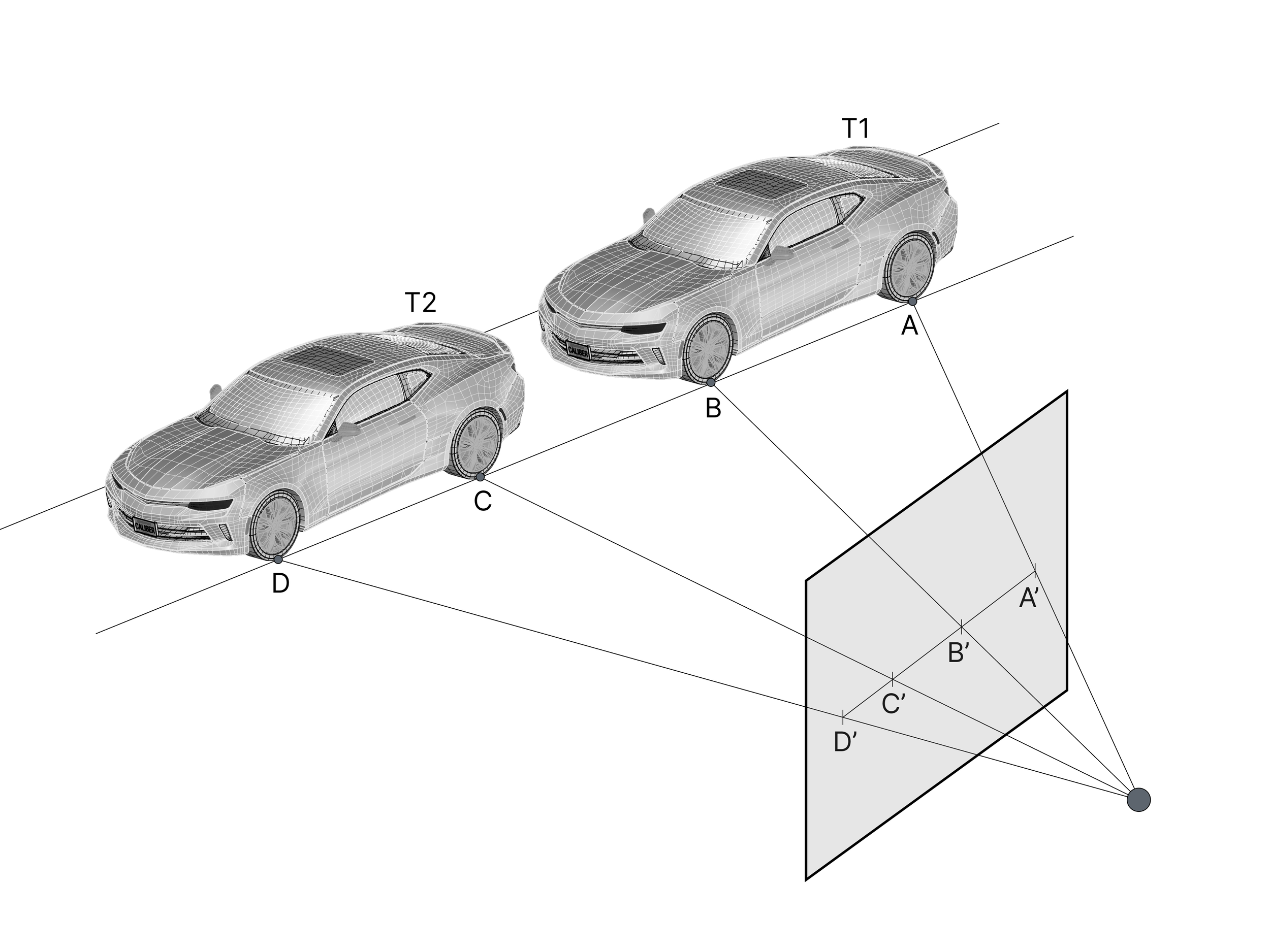
Wong et al. published an application of the cross-ratio method to collision reconstruction in 2014, and we improved the equations primarily by using vectors instead of scalars to eliminate discontinuities and travel distance limitations. Because it accounts for direction, we're calling the updated version the Directed Cross-Ratio (DXR) method, and it's been integrated into vPrism, where the research analyses were performed. Here are the preliminary results:
Stationary cameras: 110 calcs, spanning 7 to 46 mph. Mean absolute errors (MAE) were 0.2 to 0.3 mph. No errors exceeded 1 mph, and 96 were within 0.5 mph of the control.
Moving cameras: constant speed MAE was 0.6 mph. Aggressive braking produced errors of several mph over individual analysis intervals, traced to pitch and yaw between frames. A practical correction method was derived, reducing the max error to 1.3 mph and the MAE to 0.4 mph.
The manuscript is being prepped for SAE and will detail everything, including practical guidance. After working with the method extensively, I can confidently say it’s robust and worth having in the toolkit.
Thanks for reading, keep exploring!
Lou Peck
P.S. Just ride it out!