
Do Worn Tires Provide More Grip?
Each year, I review the recon-related papers published in SAE and dive into the ones I find most interesting or useful. One such paper was recently written by Changsu Kim and Yoshinori Saito, engineers from Hyundai and Michelin.
As EVs and increasingly sophisticated ECUs push control technology forward, the authors indicate that accurately understanding how tire grip changes with wear becomes essential.
While the motivation for their investigation is vehicle design, the data speak directly to questions we face as recons. How much grip did those worn tires really have? Did those bald rear tires contribute to the loss of control? Does the drag factor need adjusting?
To investigate how wear affects performance, Kim and Saito tested new, 50% worn, and end-of-life (EOL) tires under dry, wet, and snowy conditions. Before track testing, they measured the size of the contact patch and stiffness, which they state are closely related to grip performance.
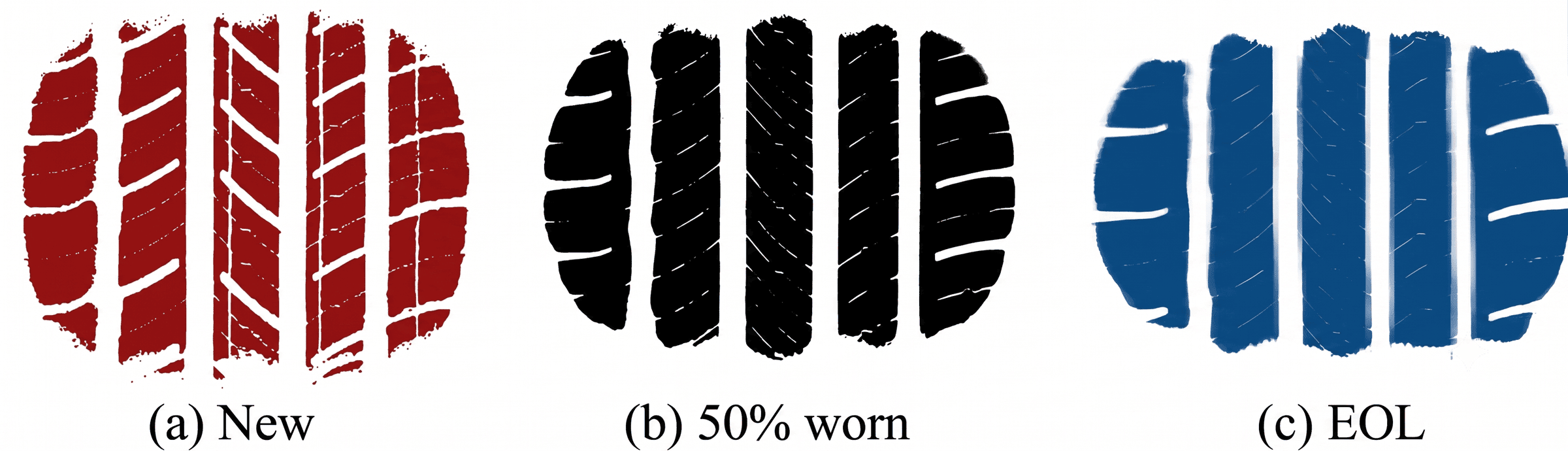
It's always interested me how the contact patch changes with pressure and wear. As shown below, the shape of the patch changed notably from the new to 50% tire, but less so after that. Ultimately, the net contact area increases with wear. The authors attributed this to chamfered corners at the lateral grooves in the tread pattern: when new, the chamfers add void space, and as they wear away, that void becomes rubber on the road (think slicks).
They also measured the lateral forces the tires generated at various slip angles. While it might be counterintuitive, the worn tires produced a slightly larger peak lateral force than the new tires, likely due to the increased contact area. More significant is where that peak occurs: reduced tread depth increases cornering stiffness, so worn tires build lateral force faster and reach their peak at a lower slip angle, leaving stability control systems a narrower band of slip to work within.
Similar behavior was observed during the track-based braking tests, where slip ratio vs. longitudinal force (i.e., coefficient of friction) curves were documented. Again, the worn tires produced greater peak force on the dry surface, and the slope leading to that peak was steeper. As seen below, the peaks occur at ~7 to 12% slip ratio (0% is free rolling, 100% is locked).
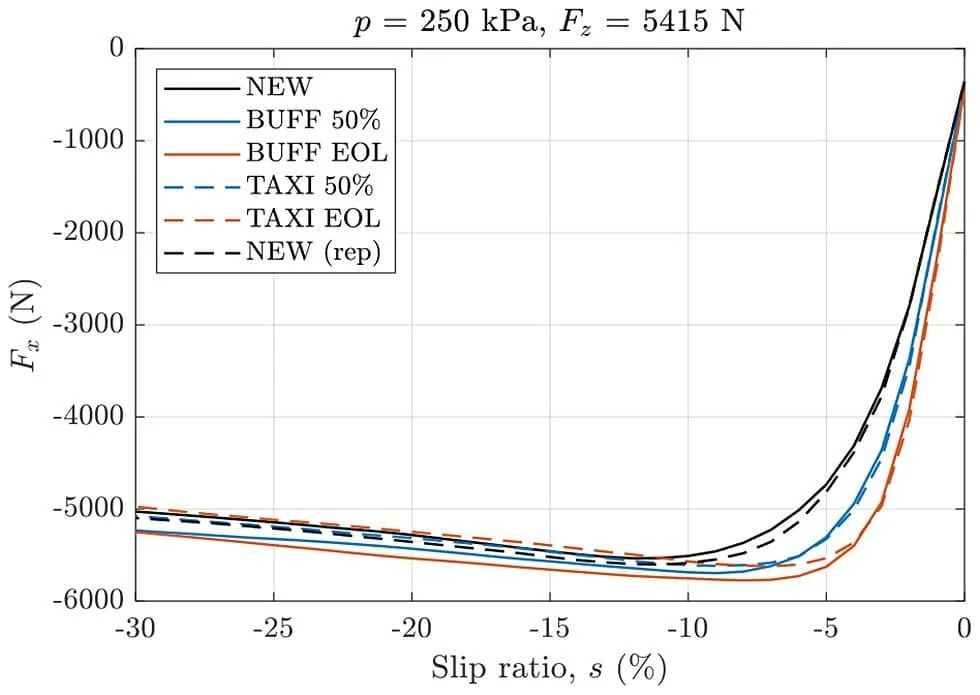
As might be expected, things flipped in the tests with ~1 mm of water on the roadway. There, the average peak force was reduced by 8.5% for the 50% tires and 19.2% for the EOL tires. A similar trend was found during tests where the roadway was covered in medium and hard pack snow.
The analysis was capped off with dry ABS braking simulations from 62 mph (100 kph). The conclusion: the EOL worn tires bring the vehicle to a stop 6.6 feet (2 meters) quicker than the new tires. Again, counterintuitive… unless you consider the data above.
I find the behavior and nuances of tire performance fascinating, and I think most of us have been involved in cases where tire wear is a topic of conversation, so it’s always good to know and explore more!
Thanks for reading,
Lou Peck