
How GPS Speed is So Accurate
I had a conversation this week with a very intelligent and knowledgeable recon who wasn't aware that GPS-derived speed data could be highly accurate. I’m sure they’re not alone, and we see GPS data all over the place nowadays (infotainment, Uber, Lyft, cell phones, GoPros, data acquisition systems, etc.). So, here’s a quick and dirty crash course.
Firstly, when a device only reports GPS coordinates and timing, we’re generally left to calculate the travel distance between points using the Haversine formula, then divide that distance by time. It’s messy, potentially producing errors of several mph, and you’ll likely have to perform some filtering to get a sensible speed trace. See this TtP edition for more on that.
That's not what's happening when devices like the VBOX, Racebox, or even a GoPro use satellites to determine speed. Instead, they're analyzing the Doppler shift in the signals received from each satellite, which can produce incredibly accurate speed measurements. Phone chipsets measure speed this way too, but that number doesn't always survive the production process, so sometimes we only get coordinates and timestamps. I have much to learn there.
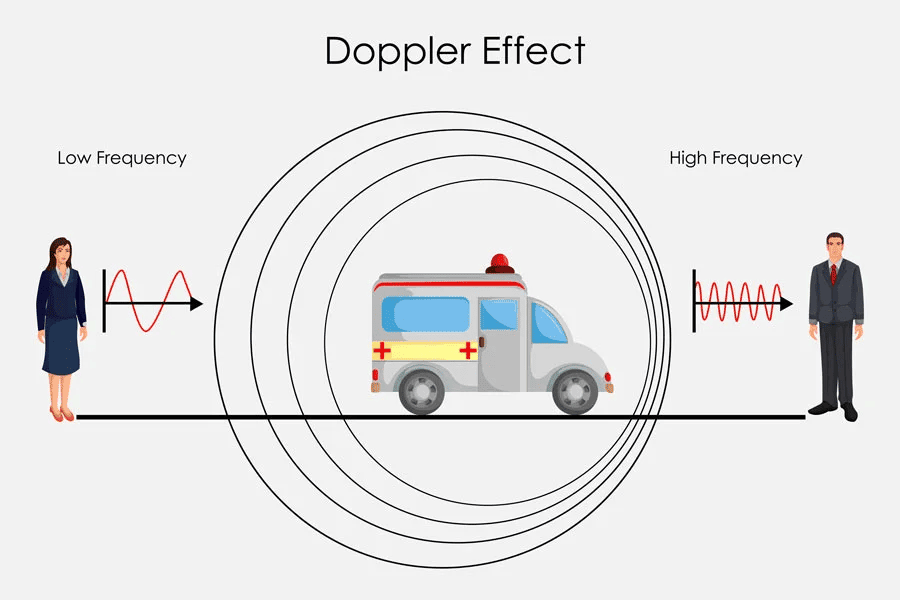
From vboxautomotive.co.uk
How accurate can Doppler get? It depends on antenna quality and processing, but according to Racelogic: “If you are tracking seven satellites, [it's] like having seven police radar guns aimed at you: the measurement is made by taking them all into account.”
So, what kind of accuracy do we get when using Doppler shift? For the Racelogic VBOX Sport, a small, $600 GNSS-only device, accuracy is 0.06 mph (datasheet here). Spending tens of thousands gets you higher acquisition rates, more potential inputs, and often a beautiful Kalman-filtered IMU. The latter helps in many ways (GPS dropouts, noise, correcting for pitch and roll), but not much with overall speed. The speed accuracy seems to still sit at six hundredths of a mph... but that’ll typically get the job done!
On a related note, we recently did some speed-from-video testing using a ScenePro for control. That system takes the approach a step further, combining GNSS with an inertial navigation system (INS), and every unit ships with a calibration certificate. Its speed accuracy may be even better than 0.06 mph, but I’m waiting on official word. I’ll provide an update in a future edition.
Thanks for reading, keep exploring!
Lou Peck
P.S. The cross-ratio method is now in vPrism version 1.0.22! Check out how to calculate speed from video in under two minutes here.